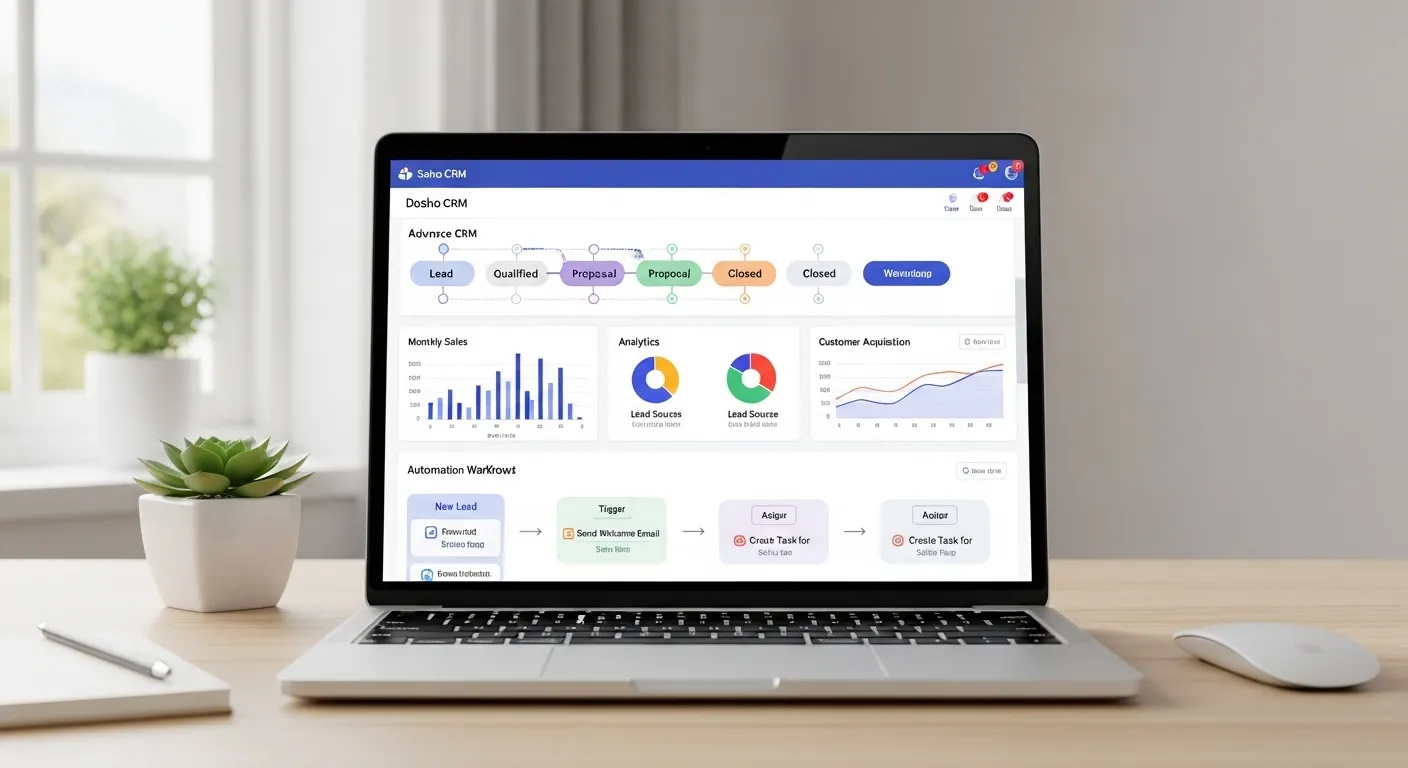
Zoho CRM is widely known as one of the most cost-effective enterprise-grade customer relationship management platforms in 2026. It delivers advanced sales automation, deep customization, and seamless integration within the Zoho ecosystem at highly competitive pricing.
Designed for scaling businesses, Zoho CRM combines flexibility with affordability, making it one of the top CRM software 2026 choices for companies seeking powerful features without high enterprise costs.
What is Zoho CRM?
Zoho CRM is a cloud-based customer relationship management system that serves as a centralized hub for managing leads, contacts, deals, and customer interactions across the Zoho business ecosystem. It is designed to support businesses ranging from startups to large enterprises through flexible configuration and scalable architecture.
Unlike CRM platforms focused only on sales, Zoho CRM integrates deeply with marketing, customer support, finance, and project management tools within the Zoho suite. This creates a connected ecosystem where customer data flows seamlessly across departments, providing a unified view of every customer relationship.
The platform follows a modular approach, allowing businesses to start with essential CRM features and expand functionality as their needs grow. This ensures cost efficiency while enabling long-term scalability without switching platforms.
Zoho CRM is fully web-based and accessible from any device with an internet connection. Dedicated mobile apps further enhance productivity, enabling sales teams to stay connected and efficient while working remotely or in the field.
Key Features of Zoho CRM
Lead and Contact Management allows businesses to capture and organize leads from websites, email campaigns, social media, and multiple other channels. Detailed contact profiles include interaction history, company data, and social insights, enabling highly personalized communication.
Sales Pipeline Management provides visual deal tracking with customizable stages that align with different sales processes. The drag-and-drop interface simplifies updates, while automated alerts ensure teams never miss important opportunities.
Workflow Automation eliminates repetitive tasks through rule-based triggers that assign leads, send emails, create tasks, and update records automatically, allowing teams to focus more on revenue-generating activities.
Zia AI Assistant enhances Zoho CRM with predictive analytics, sales forecasting, anomaly detection, and natural language processing. It helps teams identify high-value opportunities and make smarter data-driven decisions.
Canvas Builder enables advanced customization without coding, allowing businesses to design custom layouts, modules, and fields that match their specific workflows and industry requirements.
Multi-channel Communication centralizes email, phone, social media, and live chat interactions into a single interface, ensuring consistent communication and complete interaction history across all touchpoints.
Blueprint Process Management enforces structured workflows by defining required actions, approvals, and validation rules, ensuring consistency across sales processes while maintaining flexibility.
Advanced Analytics and Reporting deliver detailed insights into sales performance, customer behavior, and revenue trends through customizable dashboards and reports, enabling real-time decision-making.
Use Cases of Zoho CRM in Real Businesses
Small businesses use Zoho CRM to build professional sales systems at a low cost, starting with lead tracking and expanding into marketing automation, customer support, and finance tools within the Zoho ecosystem.
Manufacturing companies rely on Zoho CRM to manage complex B2B sales cycles, including quotations, approvals, and extended decision timelines. Integration with Zoho Books and Inventory ensures smooth order fulfillment and billing processes.
Service-based businesses utilize Zoho CRM to manage client relationships from proposal to project delivery. Consulting firms and agencies benefit from integrations that connect sales, project management, and billing.
Real estate agencies customize Zoho CRM to manage property listings, client preferences, and automated follow-ups, streamlining lead matching and transaction workflows.
E-commerce businesses integrate Zoho CRM with online stores to track customer behavior, manage inventory data, and deliver personalized customer experiences across multiple channels.
Non-profit organizations use Zoho CRM to manage donors, volunteers, and fundraising campaigns. Custom modules support grant tracking, event management, and impact reporting without high software costs.
Pros and Cons of Zoho CRM
Advantages of Zoho CRM begin with its affordability, offering enterprise-level CRM features at a significantly lower cost compared to premium competitors. Even entry-level plans include advanced tools typically found in higher-tier systems.
Extensive customization capabilities allow businesses to tailor the CRM according to their workflows without requiring technical expertise.
Deep integration within the Zoho ecosystem connects more than 50 applications, creating a unified business environment that reduces dependency on multiple tools.
Scalable pricing ensures businesses can grow without major cost increases, paying only for the features they actually use.
AI-powered insights through Zia provide advanced analytics and forecasting, improving decision-making and sales performance.
Strong mobile applications enable teams to manage CRM tasks anytime and anywhere, ensuring continuous productivity.
Disadvantages of Zoho CRM include its complexity for new users. The extensive feature set can feel overwhelming for businesses looking for a simple CRM solution.
The learning curve can slow down initial adoption, especially for teams transitioning from basic tools, often requiring training and setup time.
Customer support response times may not match premium platforms, and users may need to rely on documentation for troubleshooting.
User interface consistency varies across modules, which may affect the overall user experience.
Integrations outside the Zoho ecosystem may require technical setup, making them less straightforward compared to plug-and-play solutions.
Final Verdict: Is Zoho CRM Worth It in 2026?
Zoho CRM delivers exceptional value for businesses seeking powerful CRM functionality without high enterprise costs. It is particularly well-suited for small and growing businesses that need scalability, automation, and customization within a controlled budget.
For companies with complex workflows, Zoho CRM provides the flexibility required to manage advanced sales processes while maintaining cost efficiency. Its adaptability and ecosystem integration make it a strong long-term investment.
However, businesses that prioritize simplicity and quick setup may find Zoho CRM overwhelming due to its extensive capabilities. The platform is best suited for organizations willing to invest time in configuration and training.
Large enterprises with bigger budgets may still prefer platforms like Salesforce or Microsoft Dynamics 365, but Zoho CRM offers comparable features at a fraction of the cost.
In 2026, Zoho CRM continues to stand out with strong AI innovation, automation capabilities, and affordable pricing. For businesses focused on maximizing ROI, it remains one of the best enterprise-grade CRM solutions available.
Its ability to deliver powerful CRM tools without financial strain makes Zoho CRM an ideal choice for businesses aiming to scale efficiently without overspending. 🚀